Capping income taxes for millionaires and corporations could lead to huge sales tax increase for working families
Taxes are how we come together to fund the things our families and communities want and need to live well: excellent public schools, affordable healthcare, accessible child care, effective disaster prevention and recovery, efficient transportation systems, safe environments, and more.
North Carolina’s most important source of tax revenue — the state income tax — is on the ballot this fall: During early voting and on Election Day, North Carolinians will vote on an income tax cap amendment that would lower the maximum allowable income tax rate to just 3.5 percent, a cap that applies to both personal and corporate income taxes.
A lower cap will have no immediate effect on how much people and corporations are paying in taxes. That’s because personal and corporate income tax rates will already be below the proposed 3.5 percent cap in 2027. What the amendment will do is lock in 13 years’ worth of income tax cuts for profitable corporations and very wealthy households, blocking lawmakers from generating $17 billion per year in revenue — an amount that will grow over time.
In a state that ranks last in the nation in its effort to fund public schools — and that suffers from numerous underfunded needs, from early childhood education to disaster resiliency to affordable housing and more — adequate state revenue is required to secure opportunity and a decent quality of life for every person. But proposals that would meet those funding needs by raising income taxes above 3.5 percent on millionaires and profitable corporations — as the Kids Over Corporations Act and Fair Share For Public Schools Act would have done if passed in the 2026 legislative session — would be blocked by the income tax amendment on November’s ballot.
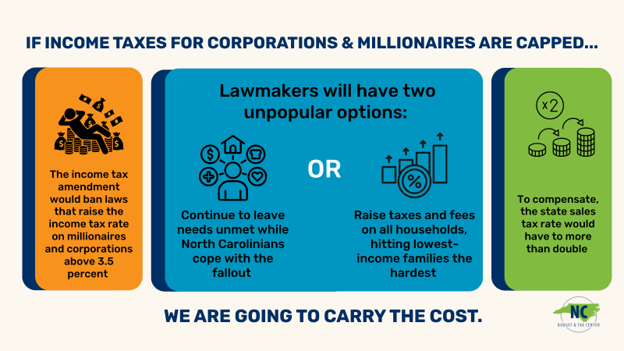
When lawmakers are prohibited from meeting funding needs by reversing tax cuts for the wealthy few, they are limited to two unpopular options: continue to leave funding needs unmet and let North Carolinians cope with the fallout, or raise other taxes and fees on all households, hitting low- and moderate-incomes households the hardest.
Take the state’s second most important source of revenue as one example: the sales tax. In order to raise the $17 billion blocked by a lower income tax cap, North Carolina’s state sales tax rate would have to more than double, increasing to 11.51 percent from 4.75 percent. It is not unlikely that lawmakers may need to consider revenue increases along these lines, given the state’s current revenue trajectory: Cumulatively, over the next eight years, revenue losses from scheduled personal and corporate income tax cuts total more than $37 billion.
A higher sales tax rate that replaces lost income tax revenue would hit lowest-income North Carolinians the hardest — precisely the households that are struggling the most with low wages and a rising cost of living. As the chart below shows, a sales tax rate of 11.51 percent would equal an average tax increase of over $500 for the 1 in 5 North Carolina households with incomes below about $25,000, a tax hike equal to about 4 percent of household income. Meanwhile, the richest 1 percent of households — with average incomes of over $1.8 million — would easily absorb their increase of about $12,000 on average, since that amounts to just 0.65 percent of their household income.
North Carolinians already know what it looks and feels like when corporations and the wealthy few don’t pay what they truly owe in income taxes: child care centers closing their doors, school buses that never arrive, high teacher turnover, higher college tuition and fees, new tolls on ferries that used to be free, higher health care premiums for state employees, and disaster relief that is too little and too late. Compensating for these unmet needs with a higher sales tax rate would increase hardship for families struggling the most to afford the basics.
It doesn’t have to be this way: North Carolina is a prosperous state, and by retaining the ability to raise taxes on corporations, millionaires, and billionaires, North Carolinians can live the life we all want for our communities. We deserve affordability and well-being. North Carolinians deserve to thrive.