House Bill 1073 / Senate Bill 1016: Fair Share for Public Schools Act
Less than 1% of North Carolinians can fund $1 billion for 1.5 million public school children in NC
Link to HB 1073 / SB 1016, filed April 28, 2026
HB 1073 / SB 1016 Summary: This bill creates a 7% personal income tax rate on income over $1 million and directs those funds to public schools across the state through the State Public School Fund.
Millionaires in NC have gotten billions in tax breaks each year under the state’s current low, flat personal income tax schedule.
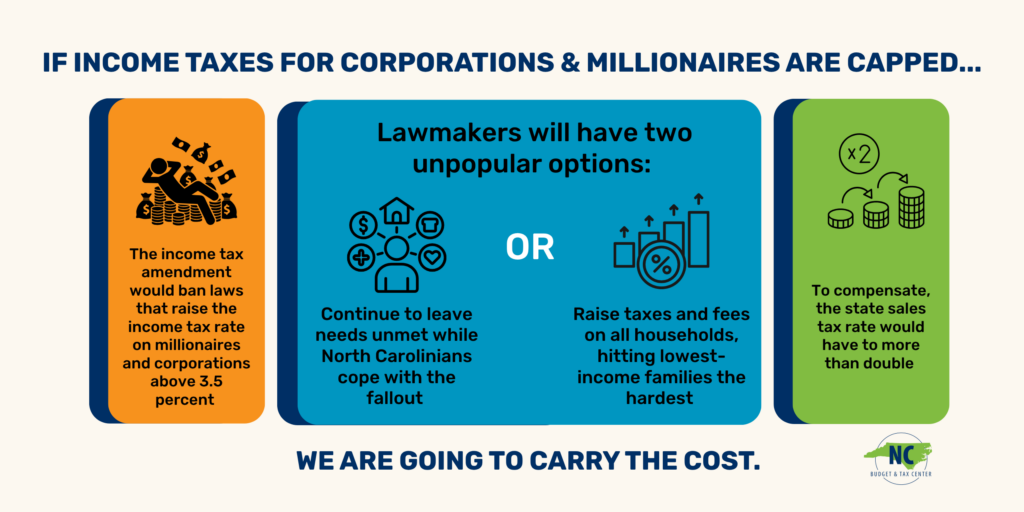
North Carolina’s current tax code is upside-down[i]. It asks people with the lowest income to pay the greatest share of their income in state and local taxes, while the richest 1 percent pay the least. The adoption of low, flat personal income tax rates since 2013 continues to deliver the greatest tax cuts for the richest 1 percent.
- Higher rates on higher income allow the state to offset the regressive nature of sales and property taxes.
- A higher rate on income over $1 million allows the state to raise significant critical funds without adding to the tax load of middle- and low-income North Carolinians.[ii]
The bill would:
- Create a 7 percent rate on income over $1 million, impacting just 0.6 percent of state tax returns;
- Ensure that personal income tax rate reductions triggered by meeting revenue thresholds do not affect this rate;
- Add an estimated $1 billion in funding for public schools to be distributed through the per pupil formula established in the state Constitution;
- Allow the Department of Revenue to retain funds for the administration of the tax.[iii]
Recent federal tax cuts shift costs to states, require new revenue to protect and expand funding to public schools and more.
North Carolina’s revenue projections show year-over-year declines[iv] in state collections for public services over the next fiscal year. Already the state is making the least effort of any state to fund public schools. And at the same time, the cost of delivering current services is increasing and new costs will be required of states to ensure people can access food assistance and health care. Raising new revenue will ensure that the state can fund these costs and make a greater commitment to fund public schools.
More about HB 1073/SB 1016
- The distribution of funds to public schools uses the process that is considered the “backbone” of the State Public School Fund which determines the number of teachers, teaching assistants, support personnel, bus routes and instructional resources. [v]
[i] https://itep.org/whopays-7th-edition/
[ii] https://itep.org/the-pitfalls-of-flat-income-taxes-2025/
[iii] https://www.ncleg.gov/Sessions/2025/Bills/House/PDF/H1073v1.pdf
[iv] https://ncbudget.org/north-carolinas-revenue-forecast-is-a-wake-up-call/
[v] https://www.ednc.org/wp-content/uploads/2024/03/2024_03FundinginArrears_Action_ppt_387846pdiosjzimpplqnpoo3zdyqyz-2.pdf