
Senate Bill 943: Kids Over Corporations Act
Raises the state corporate income tax rate to 5%
Link to SB 943, filed April 29, 2026
SB 943 Summary: This bill would stop the scheduled elimination of the corporate income tax and instead set the corporate income tax rate at 5 percent, beginning in Tax Year 2026.
Stops the elimination of the corporate income tax.
State lawmakers have already cut North Carolina’s corporate income tax rate to just 2 percent in 2026, down from 6.9 percent in 2013, without any evidence for rate cuts translating into positive economic outcomes. Because corporate taxation is based on the location of a company’s sales, and not on the location of facilities or workers, cuts to the rate simply enrich multi-state or multi-national companies that happen to sell into our state, regardless of whether they’ve made any meaningful investments here or not.
The current rate of 2 percent is already the lowest in the country among the 44 states with this tax. Because of repeated tax cuts since 2013, corporations this year saved about $3 billion on state income taxes in North Carolina — public revenue that otherwise would have been available to fund public schools and other state investments.
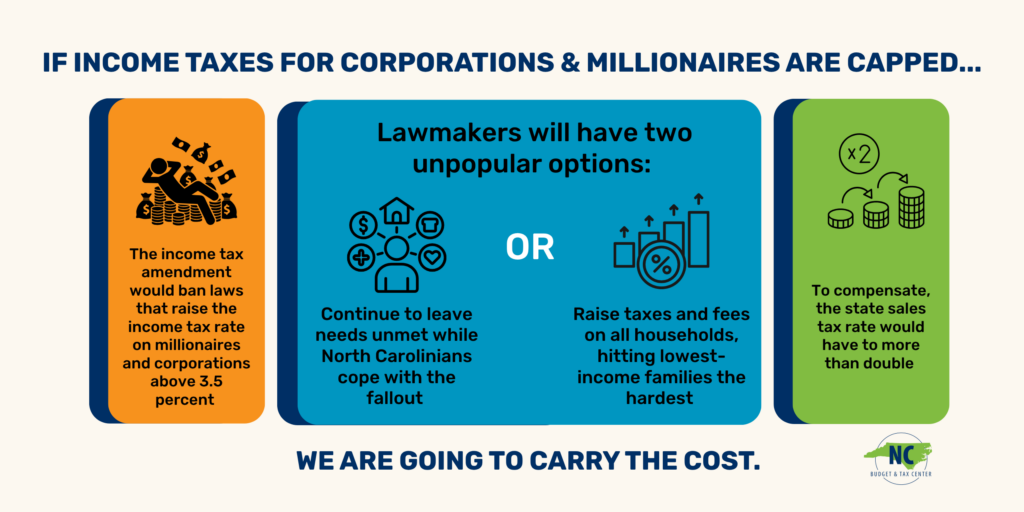
Under current law, the corporate income tax rate will continue to decrease in the coming years and be eliminated completely beginning in 2030, costing the state an additional $1.3 billion in annual lost revenue relative to the current rate of 2 percent. This bill would repeal the elimination of the corporate income tax and, instead, raise the rate.
Raises the corporate income tax rate to align with neighboring states.
This bill would raise the corporate income tax rate to 5 percent beginning in Tax Year 2026, a rate more aligned with neighboring states, including Tennessee (6.5 percent), Virginia (6 percent), Georgia (5.19 percent), and South Carolina (5 percent). Relative to current law, this bill would raise $2 billion in revenue to fund public priorities such as K-12 public education, a figure that would grow over time as corporate profits increase. Over 90 percent of this corporate tax increase would ultimately fall on out-of-state residents, mainly corporate executives and shareholders.
While North Carolina is estimated to rank 46th in average teacher salary, neighboring states with higher corporate income tax rates all place higher in the average teacher pay rankings: Georgia (22nd), Virginia (23rd), South Carolina (31st), Tennessee (39th). Two decades ago, before the Great Recession and cuts to the corporate income tax rate began, North Carolina ranked as high as 24th in average teacher pay.