House Republicans’ Extreme Budget Plan Fails North Carolina Families, Children, and Communities

Note: An updated version of this fact sheet about the final bill is available here.
House Republicans passed legislation that would raise costs on North Carolina families and take health coverage, food assistance, and other essentials away from North Carolinians who are already struggling to make ends meet — all while showering ever larger tax breaks on the wealthiest households. 2.8 million North Carolinians now get health coverage through Medicaid and 1.42 million North Carolinians receive food assistance from the Supplemental Nutrition Assistance Program (SNAP). Both programs are being targeted for the largest cuts in their history under the House-passed budget reconciliation bill. The bill will hurt a broad swath of families across rural, urban, and suburban parts of the state and targets people who are immigrants and their families for particularly harsh treatment.
Raises Costs and Increases Hardship for North Carolinians
Makes health insurance away from North Carolinians and makes it more costly
- Creates more red tape and barriers to coverage through harsh new Medicaid work requirements that could leave as many as 496,000 North Carolinians in the expansion population without health coverage.
- Fails to continue the enhanced premium tax credits that help low- and middle-income families and small business owners afford health coverage, resulting in skyrocketing premium costs for North Carolinians. For example, a 60-year-old North Carolina couple making $82,000 would see their annual premiums for a benchmark plan increase from $6,970 to over $25,840. Additionally, 74,000 North Carolinians could lose health coverage altogether due to the high premium costs.
- Takes away Medicare and affordable ACA marketplace coverage from certain people with lawful immigration statuses including refugees, people granted asylum, and some victims of domestic violence and sex or labor trafficking.
- Cuts federal Medicaid funding to North Carolina unless it stops providing comprehensive health coverage to adults granted humanitarian parole. If North Carolina does not end this coverage, its Medicaid expansion match rate will fall from 90 to 80 percent costing $6 billion in federal funding through 2034. This reduction would “trigger” a state law that ends the Medicaid expansion if the expansion federal match rate is reduced, forcing the state legislature to make an unconscionable choice.
Raises the cost of groceries for up to 1.42 million North Carolinians
- Requires states for the first time to pay a minimum of 5 percent and up to 25 percent of SNAP food benefit costs, which could force between $146 million and $731 million in new costs onto North Carolina. If North Carolina lawmakers can’t meet this unfunded mandate, they would have to either reduce the state’s costs by cutting benefits or the number of people who get SNAP, or opt out of SNAP entirely, which would leave North Carolinians without the food assistance they need to buy groceries and would negatively impact grocers, especially in rural communities.
- 375,000 North Carolinians would be at risk of losing some of their food assistance, including many children, under a significant expansion of SNAP’s already harsh, ineffective, and red tape-laden work requirements to parents and other caretakers of children aged 7 and up and adults aged 55 to 64. In addition, North Carolina would only be able to waive the work requirement in counties where the unemployment rate exceeds 10 percent, even during a recession.
- Takes away food assistance from certain people with lawful immigration statuses including refugees, people granted asylum, and some victims of domestic violence and sex or labor trafficking.
Passes the buck to North Carolina lawmakers
- House Republicans would make their enormous cuts to food assistance and health care in part by shifting dramatic new costs onto state governments, such as by requiring states to absorb a portion of SNAP benefit costs for the first time ever, cutting federal funding for state administrative costs in SNAP, implementing new forms of red tape that will increase uncompensated care costs, and restricting how states can fund their Medicaid programs in ways that will make states and localities pick up more of the cost if they want to keep their programs stable.
- These higher costs will be hard for North Carolina to shoulder even when times are good, let alone now as finances are under growing strain and the economy is flashing warning signs. In response to these added costs, North Carolina lawmakers would have to either raise taxes or cut back on vital health care and food assistance, as well as investments in a range of other public goods like schools and infrastructure, since the state is required to balance its budget.
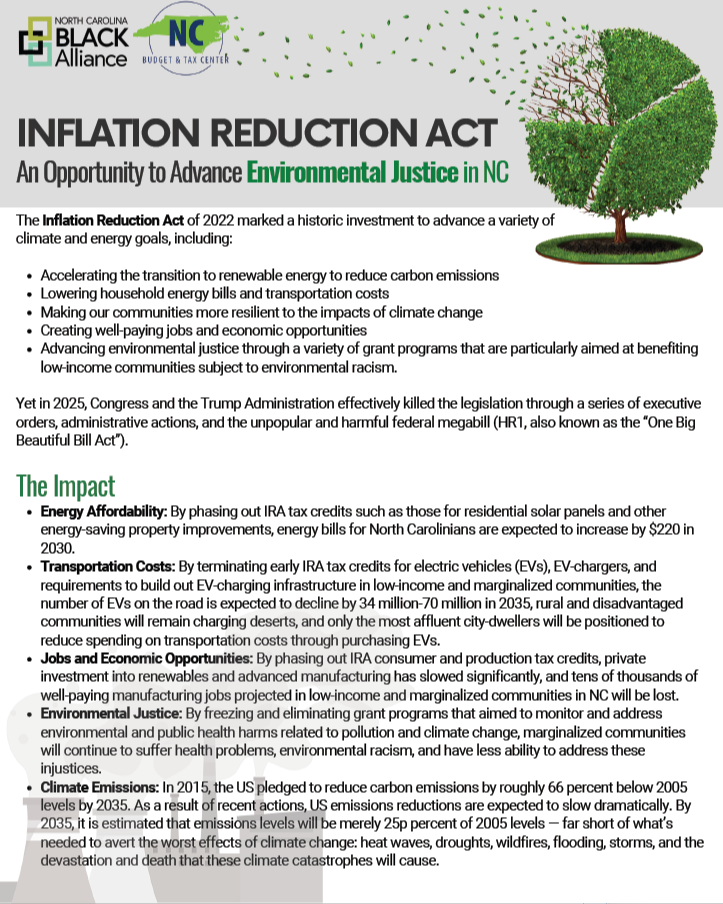
Increases energy prices while cutting jobs
- Cuts more than $500 billion from clean energy tax credits, which will raise the cost of installing the lowest-cost energy — wind and solar — and cause two-thirds of planned projects nationwide to be canceled. This could lead to energy prices increasing by roughly 14.4% for households per month and 20,300 jobs lost in North Carolina.
Makes college less affordable for North Carolina students
- Cuts more than $350 billion in investments that make higher education more affordable, including changes to Pell Grant eligibility rules, which could result in 44,800 low- and middle-income North Carolina students losing all federal aid and another 97,800 students losing some aid. The bill also takes away access to federal financial aid from certain people with lawful immigration statuses including refugees, people granted asylum, and some victims of domestic violence and sex or labor trafficking.
Delivers Massive Tax Cuts to the Wealthiest North Carolinians While Failing to Deliver Support to Working Families and Children
Gives more tax cuts to the wealthy
- In 2026, the House tax plan gives the richest 1 percent of North Carolinians, earning more than $867,100 a year, an annual tax cut of $69,650. In contrast, the lowest-income North Carolinians, earning less than $24,900, would receive only $80 while also bearing the brunt of deep cuts to Medicaid and SNAP and facing higher prices due to the President’s tariffs.
Leaves children in lower-income working families behind
- As many as 649,000 children in North Carolina working families would be denied the full $2,500 Child Tax Credit that higher-income families would get simply because their parents — who work important but low-paid jobs — don’t earn enough.
- Takes away eligibility for the Child Tax Credit from U.S. citizen children and those with lawful permanent residency if the parents on the tax return (both parents in a married couple family) don’t have a Social Security number (even if one parent is a citizen).