

What $950 million could mean for emergency response
When someone calls 911, we expect emergency responders to show up. This is because local governments make sure our public dollars are put to use to pay and retain workers who keep our communities safe and provide the essential equipment they need to respond — from fire trucks to personal protective equipment.
But firefighters, EMTs, paramedics, police officers, and others cannot reliably show up if local governments’ largest source of revenue — property taxes — is restricted. In other parts of the country where local governments have limited revenue options, residents have seen delayed response times, new fees for emergency services, and even higher insurance premiums.
This November, voters will be asked to approve a constitutional change that could leave local governments with fewer resources to sustain the emergency workforce and services they count on. The misleading property tax amendment would give state legislators the power to limit local governments’ primary source of revenue, even as communities grow, costs rise, and the state and federal governments push new costs onto local budgets.
This is a bad deal for everyday North Carolinians: the tax amendment would do little to meaningfully lower property tax bills while putting the local services people rely on at risk.
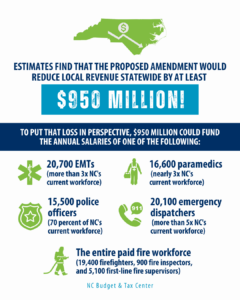
Estimates find that the proposed amendment would have reduced local revenue statewide by at least $950 million during the most recent revaluation cycle. To put that loss in perspective:
Emergency responders are already asked to serve for little pay
Limiting local revenue will make it harder to fill critical public safety positions and ensure those workers are paid enough to afford their basic needs. Many emergency responders already earn too little to make ends meet, despite working irregular hours in jobs that can put their safety at risk.
The proposed property tax limit also comes at the same time that departments are struggling with staffing shortages and growing calls for service. Low pay only makes it harder to recruit and retain enough workers to keep up with communities’ needs.
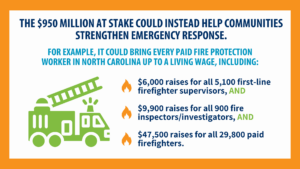
The $950 million at stake could instead help communities strengthen their public safety workforce.
North Carolina fire services are already stretched
The property tax limit could especially make it harder for North Carolina’s fire services to keep up with growing staffing needs and rising costs. Fire departments are already facing two major pressures that will require more revenue in the years ahead:
- A shift toward more paid staffing. More than 60 percent of North Carolina firefighters currently serve as volunteers, but departments are increasingly moving towards professional or mixed-staffing models. For many departments, this shift is driven out of necessity. Volunteer firefighters often have day jobs, leaving departments struggling to find enough firefighters to serve during the day. Hiring paid staff can fill those gaps but requires reliable revenue to pay and retain workers.
- The rising cost of fire protection. At the same time departments need more resources for staffing, costs of fire engines, fuel, protective equipment, and other essentials have skyrocketed. Those costs will continue to rise whether or not local governments have the revenue tools needed to keep up.
Rural communities could struggle the most with these pressures. Their sparse populations often require rural fire departments to stretch limited staff and equipment across greater distances. Some communities even depend on neighboring departments’ staff to make sure enough firefighters can respond to an emergency. At the same time, many rural communities rely on fire districts funded by dedicated property taxes to support fire protection, often provided by volunteer departments. That means a property tax limit could restrict the dedicated revenue these districts depend on to keep fire services running.
North Carolinians can come together to make sure that every community has the ability to respond to an emergency and keep our families and communities safe. But limiting our ability to fund these services will create more barriers to this very basic foundation of well-being.