
Telephone Townhall Event: Western NC Helene Recovery
- Take action: Tell NC lawmakers: What do you need to recover and rebuild from Helene?
- Blog: NC needs a bold response from lawmakers to Hurricane Helene disaster
- Fact Sheet: NC needs a full and inclusive recovery for Western NC post-Helene
- Join the North Carolina Inclusive Disaster Recovery Network
Transcript
The recording above and this transcript have been edited to delete repeated remarks from the moderator; none of the remarks from western North Carolinian speakers have been edited or removed.
00;00;00;00 - 00;00;12;19
Good evening, everyone, and welcome to tonight's Telephone Town Hall, hosted by the North Carolina Budget and Tax Center. The NC Inclusive Disaster Recovery Network, and MDCC, Inc..
00;00;12;19 - 00;00;23;29
Thank you so much for being here. And my name is Dani Hoffpauir. I am with NC Budget and Tax Center and I am so honored to be on the call tonight with y'all.
00;00;24;01 - 00;00;52;26
This evening we're going to be discussing hurricane recovery in the aftermath of Helene. And we have about 35 lawmakers on the line listening. Thank you for being here tonight. The goal for tonight is to give western North Carolinians the opportunity to share live with these lawmakers, your stories, needs, and priorities for recovery. So if you have a story you'd like to share, you can just press zero on your keypad.
00;00;52;26 - 00;01;17;25
If you're on your phone now to be added to the queue. We want to try to hear from as many people as possible. So we're limited. We're limiting each person to two minutes. So please be brief. And if you start going over two minutes, we'll have to mute you. It's nothing personal, I promise. We just want to make sure that we hear from as many people as possible tonight.
00;01;17;27 - 00;01;41;27
And please note that this is a nonpartizan space. I know that this is a challenging time, and we understand that folks are frustrated and all lawmakers are accountable to the people. And we want to take to task lawmakers who don't put people first, regardless of parties. But if you start making your remarks about party politics, we will have to mute you.
00;01;41;27 - 00;01;55;03
So we are going to get started. We're going to kick it off with, Sam Stites from Just Economics, who lives in Transylvania County.
00;01;55;06 - 00;01;58;01
Sam, the line is yours.
00;01;58;01 - 00;02;17;07
Thank you so much. I'm calling from Transylvania right now, and I'll jump right in. We need grants for small businesses, and we need them badly. And I work with employers to pay a living wage in 17 western counties. And since the storm, I've been periodically checking in with many of these employers.
00;02;17;07 - 00;02;40;07
And I just want to share what a few of them have told me verbatim. One said, we have laid off the majority of our staff. Another one in Henderson County told me we are hanging in there and hoping for some grants to come through. That was in November. Another told me while we didn't suffer physical damage, we hurt when our clients hurt.
00;02;40;09 - 00;03;06;20
So small business grants are absolutely critical to preventing a failing economy. We lost out on an entire league season and we need to have a bigger share of this conversation. Western North Carolina needs to be centered in these conversations. The second thing that I'm here to say is that we desperately need rental assistance. We have needed it since October 1st, and every other day that rent has been due for people who are now unemployed or underemployed.
00;03;06;26 - 00;03;31;10
Likely they work for those struggling businesses or ones that have already closed some who are housing relatives and preventing further lack of housing. The response and funding by the legislature on rental assistance has not been adequate, and I don't see how we recover without it. The most recent bill, HB 47, includes no rental assistance, but it does include $10 million for volunteer organizations providing relief, unspecified.
00;03;31;13 - 00;03;50;28
I'll say there are plenty of worthy organizations or a handful of worthy organizations keeping people off the winter streets, paying people's rent, and running out of funds that could be seeing some of this money, if not all, last, members of the Assembly have repeatedly justified the low relief packages by telling us that they want to let the feds do the heavy lifting.
00;03;51;01 - 00;04;09;24
And now a lot of that funding is in question. Going forward, I would just ask the General Assembly to please use the opportunities you have to provide relief when you have them and to not pass the buck to an unreliable source. North Carolina should take care of North Carolina. So please, especially the Western delegates, please work together to advocate for us in a meaningful way.
00;04;09;25 - 00;04;10;21
Thank you.
00;04;10;21 - 00;04;36;09
Thank you so much, Sam, for your comments and your insight and sharing your experience as we're getting our speakers ready. We like to begin with a polling question for y'all to get a sense of y'all's priorities and relief and rebuilding work in Western North Carolina. So what is your biggest priority that you want to see addressed in western North Carolina?
00;04;36;11 - 00;05;05;17
You're going to use your keypad. We're going a bit old school. And you're going to press one. If it's housing people, you're going to press two. Is it getting small business back open? Press three if it's providing mental health and health care. Press four if it's rebuilding infrastructure like roads, water and sewer and press five. If it's focusing on those communities that have been completely destroyed.
00;05;06;05 - 00;05;17;14
And based on your poll, it's looking like priorities are, number one, housing people.
00;05;17;16 - 00;05;27;05
Two is looking like focusing on communities that have been completely destroyed. Three rebuilding infrastructure.
00;05;27;05 - 00;05;32;12
the fourth would be providing mental health and health care.
00;05;32;12 - 00;05;49;08
I think the fifth one is getting small businesses back open. So thank you so much for participating in that poll. All right. We're going to get back to hearing from our speaker.
00;05;49;08 - 00;05;55;02
So, now we're going to turn to Marcia from Grace Covenant,
00;05;55;02 - 00;06;01;08
Presbyterian Church in Buncombe County, who's going to speak about housing.
00;06;01;08 - 00;06;07;28
Thank you. This is Marcia Mount Shoop. I'm the pastor at Grace Covenant Presbyterian Church.
00;06;08;00 - 00;06;46;05
We're still in a housing crisis in western North Carolina. Grace Covenant has done $4 million in rent support since September 27th, when the storm hit. And our only barrier to providing rent support has been having the financial resources to keep going. Getting large scale funds from local funding or news organizations is really difficult. There are some typical philanthropic patterns of how financial resources tend to flow from large foundations, and they don't tend to go to grassroots organizations who are on the ground doing the work.
00;06;46;07 - 00;07;22;08
Also, a lot of people misunderstand FEMA's role. They FEMA supports people who have had housing loss or displacement or damage, but they don't do rent support for people who lose wages. It's the hidden crisis of this storm, to the workforce in in western North Carolina is really important for people to understand. There are still a lot of hard working people in our service economy who are still struggling to pay their rent, because their employers are not able to bring them back to full time wages.
00;07;22;10 - 00;07;48;21
The pre-storm wages in one day. Last week we wrote rent support support checks for a total of $184,000. Over 70% of those checks were for tenants in some phase of eviction. And people are going to start getting eviction letters again tomorrow, because today, the fifth is the day that your rent is late if you didn't pay it by today.
00;07;48;24 - 00;08;16;00
I'd like to share a brief story. I hope I have time. Yesterday we had someone come in who has a. His eviction is already in the court. He is getting evicted because he hasn't paid his January rent. He needs $2,500 to stop the eviction. He's not back to full time work yet. If he gets the money to stop the eviction, they will only file for eviction again in February.
00;08;16;00 - 00;08;38;21
If he doesn't pay his full February rent by the 12th of February. There are all kinds of policies in this apartment building and and different philanthropic organizations that mean it's pretty much impossible for him to get help. And if he gets an eviction, he's not going to be able to rent again from other people. It makes it very difficult to rent.
00;08;38;24 - 00;09;07;12
His, current property company is making him leave at the end of February because he's been late on his rent three times in the last year. Of course, four months of that, we're in the hurricane. So this is the kind of situation that we're looking at very complicated, and people really need help hanging on, paying their rent. And we're struggling now to have the resources to help people in eviction.
00;09;07;14 - 00;09;22;05
On a large scale, this is just one example of how the workforce is really retraumatized month after month. And the way a lot of systems aren't set up to support and take care of the workforce. So thank you.
00;09;22;05 - 00;09;31;18
Thank you so much, Marcia, for speaking tonight and sharing that with us. So let's go straight to Renny.
00;09;31;20 - 00;09;42;02
Tonight Renny is joining us, who worked in Asheville restaurants for nearly 20 years and will be speaking to us about job loss and wages. You're on the line, Renny.
00;09;42;13 - 00;10;10;26
Thank you so much for the opportunity, I appreciate it. I've been in Asheville, beautiful Asheville for 16 years now. I've been cooking downtown for 16 years. I've been cooking total for 30 years now. I was here watching it become a culinary Mecca. Asheville has been on the list. Top ten list for places to come eat, places to come live, places to come vacay.
00;10;10;29 - 00;10;32;28
All of that is wiped off the board. I see on social media sites, people are thinking that the spring and summer will be back up to normal. I can honestly tell you, for as long as I've been here, I know when the peak seasons of business are and I know when the downtime of businesses here in Asheville.
00;10;32;28 - 00;11;00;27
And in all honesty, I don't need to be a fortune teller. I can tell you it's going to take many, many years. I am in the process of trying to find out how I'm going to pay for February's rent. I barely paid for January's rent. I cannot get assistance from these charities, unfortunately. I can't tell you why. FEMA did help out with the $750, but other than that, I never thought I would leave Asheville.
00;11;00;28 - 00;11;23;27
I don't want to leave Asheville. I feel like my hand is being forced, and I don't know where this help is going to come from, but I need help with my rent. I've been in the same place since I've moved here from Vermont, and I am in good standing with my property company. I don't want to go into that eviction list, and have it become that much harder to rent again.
00;11;23;29 - 00;11;42;08
I like my property company, and like I said, I want to stay in good standing with them. My bills are barely getting paid. So, anyway, listen, thank you for the opportunity. I speak for many. I speak for hundreds, if not thousands in this town. And we need help really, really fast. Thank you so much.
00;11;42;08 - 00;11;45;25
Thank you so much, Renny, for sharing.
00;11;45;27 - 00;12;18;04
I'm just really blown away by everyone that shared so far. And just very grateful for your voice, and your stories, being able to share them tonight, for lawmakers to help us, in rebuilding western North Carolina. So, thank you. And as a reminder, if you want to speak tonight to share your story, you can press zero on your keypad at any time, and you'll be added to the queue to speak for keeping remarks at two minutes or less.
00;12;18;07 - 00;12;44;17
At two minutes, you will be muted. It's nothing personal. We're just trying to hear from as many people as possible with that. I am going to welcome Miss Loretta Allen into the space, to speak to us for two minutes, and share her story. Loretta. Yes. I am, 74 years of age, and I live in a low-lying area in Surry County.
00;12;44;20 - 00;13;17;19
When Helene come in, it just flowed in. I got, the, my crawlspace flooded and I had the the black mold and everything and now my floors are sinking and and my cabinets come away from the wall. I just don't know how I'm gonna get this this fixed. I don't know, and it and and they tell me mold is not good for you.
00;13;17;22 - 00;13;36;28
Especially. I'm on dialysis, too. I want to know what, what organization or FEMA or somebody can do to help the elderly, like myself. And if you do, give me a call, I'm in Surry County. I live in Surry County.
00;13;36;28 - 00;13;45;08
Thank you. Thank you so much, Ms. Loretta. And we will definitely follow up with you.
00;13;45;11 - 00;14;03;17
And we really appreciate you sharing with us tonight. I'm so sorry that you're dealing with that. That's really awful. And I, I'm hoping that we can get the resources that you and many North Carolinians like you need so, so badly.
00;14;03;17 - 00;14;14;14
So next we are going to go to Lauren Bellinger. Lauren, you have two minutes, and, the line is yours.
00;14;14;16 - 00;14;49;24
Hi, guys. My name is Lauren Bellinger. I'm the founder of Divine Disaster Relief. We are servicing several counties, but mainly Buncombe and McDowell County. We've been putting families into camps short term, housing, which are going to be campers right now, but something that we have really ran into over the past several weeks are local landlords that experienced damage to their own homes, but also have homes that they own, that they rent, to the local communities that are not receiving any kind of assistance.
00;14;49;25 - 00;15;20;05
FEMA will not give them assistance because it is not their primary residence. As well as other, government organizations to tell you guys a story. There is a fella in Old Fort, and we were cleaning his neighbors’ debris up just this past week. He is a, he lives in Swannanoa, but his family's land is in Old Fort, one of his rentals that he rents to a family of five.
00;15;20;07 - 00;15;55;28
The house has almost ... the house has suffered a landslide. And he needs a retaining wall built. But because his own personal damage of his own house in Swannanoa, he doesn't have the funds. He's a school teacher, and he doesn't have the funds to help, or to provide for his rental property. Therefore, it's leaving another family out in the cold, essentially out in a camper that we are now paying $750 a month in camp and lot rent just to be able to help house this family.
00;15;56;01 - 00;16;15;19
This is only, one of the local landlords that we're dealing with. We really, really need assistance for these local landlords that have suffered damage from their own property. But also now that was their rental. Their rental income was how they also made a living.
00;16;16;11 - 00;16;35;07
Thank you. I'm so sorry that we have to cut you. We do want to hear more of your story. And we're going to talk about how you can do that. Later, if you got cut off or if you're not able to talk tonight. Thank you so much for sharing. So next up, we're going to go over ...
00;16;35;10 - 00;16;49;20
Well, let me say, now that we've heard from several western North Carolinians about housing and job loss. I want to move the conversation along to small business interest, an early childhood service or child care services. So
00;16;50;00 - 00;17;25;26
Like I said, there's no way that we'll be able to get to everyone. But you can share your story with us online in written form at NCbudget.org/WNC, again that is NCbudget.org/WNC. And if you leave your story there because you didn't get to speak tonight, or maybe you just don't feel like speaking tonight, but you do have a story or maybe you got cut off and you have more to say.
00;17;25;29 - 00;17;31;23
Please visit that site and we'll help amplify that to lawmakers.
00;17;31;23 - 00;17;35;28
So I'm going to keep moving this along.
00;17;36;01 - 00;17;43;20
Tonight we also have with us Meghan Rogers of the Asheville Independent Restaurant Association.
00;17;43;20 - 00;18;01;12
I'm going to pass it over to Meghan from Buncombe County. Okay. Hi there. Good evening, and thank you for the opportunity to share from the Asheville Independent Restaurant Association, also known as AIR. We're a nonprofit membership organization supporting our local restaurant community.
00;18;01;14 - 00;18;30;13
Prior to Hurricane Helene, we had about 145 members post to storm. We've lost about 15 restaurant members who are either permanently or remain temporarily closed. Those 130 members represent about 3500 employees across Buncombe County. Typically our October, November and December times are the busiest month for our restaurants, and they rely on that revenue generated during these months to sustain them through the slower winter months, the time that we're in now.
00;18;30;15 - 00;18;58;15
And the same can be said for our restaurant employees. They rely on this income to pay their bills and feed their families over the winter. What our small businesses need in the wake of Helene's destruction, which is both physical and economic, is forgivable loans, grants or other reimbursement funding. We've heard over and over and over again from our members and from industries across our region that they simply cannot take on additional debt, no matter how favorable the rates for those loans are.
00;18;58;17 - 00;19;21;02
And ideally, these forgivable loans or grants would not have too many restrictions on them, particularly as it relates to annual revenue. Often, restaurants operate on very thin margins, typically at 5% or less. I'd also like to touch on another issue that our restaurants and in my understanding, many businesses across our region are facing, which is insurance claim denials.
00;19;21;04 - 00;19;41;11
I don't yet have specific asks on this issue, but there are a lot of people getting together and working on this issue. So I wanted to flag it for our elected leaders and to touch on the needs of our restaurant and hospitality workers. You've heard it already from some of the other callers or speakers. They need their jobs and they need them to be stable and not uncertain.
00;19;41;14 - 00;19;58;25
And they need rent and mortgage assistance to ensure that they're able to stay in their homes and stay in our community. So, on behalf of AIR, I would just like to thank all of our lawmakers who are on the call and, doing everything that you're doing to support Western North Carolina's recovery. Thanks very much for having me.
00;19;59;03 - 00;20;28;04
Thanks so much, Megan, for joining us tonight. I really appreciate it. As we continue, just a reminder to folks to try to speak a little slower. I know we're trying to fit a lot into a small period, a small amount of time, but we have different people on the line and, different people have different needs. And we just want to make sure that we're speaking, so that everyone can hear and understand us.
00;20;28;07 - 00;20;59;10
So next up we have Kevin who's going to talk to us about small business recovery. Kevin, you are live. Thank you. Hi. Kevin Sandefur from Canton, North Carolina. We have a small business that was flooded in Killeen. Several the properties around us were also severely damaged. One of the challenges we're facing in the recovery phase, is that some of the structures have structurally failed around our property.
00;20;59;13 - 00;21;27;06
And, when I try to, address that with local leadership, I don't get a lot of clarification or a sense of urgency to clear hazards of, buildings that are dilapidated or in disrepair, that are safety hazards. It causes concern for liability issues for businesses that are trying to reopen. Obviously, poses an ongoing, danger for, for customers if they return to the, you know, area.
00;21;27;06 - 00;21;47;01
And, and there's, structures that are failing. Secondly, I'd like to address the, insurance industry and some of the challenges that we've faced in that, you know, here we are month, you know, five and six and still claims haven't been paid. And we just get a lot of, you know, excuses. We're working on it. We're understaffed.
00;21;47;03 - 00;22;22;23
I don't know if there can be any additional oversight, with the insurance industry in our state, but, we certainly have had a tough time, getting any of that money. Also, one other thing I'll just mention is the utilities, specifically Duke Energy. I would like to see if there's any resources there. We've received bills for services that were disconnected from the building and, don't know really where to turn to get answers on those questions, but there seems to be an ongoing charges that happened, to structures that have been, disconnected from the grid.
00;22;22;25 - 00;22;31;02
Even though, there's no service, we're still receiving bills for those addresses. And I'd like to thank you for the opportunity to speak.
00;22;31;02 - 00;22;44;05
Thank you so much for sharing, Kevin. And being here with us tonight, if you would like to speak, this is a reminder. You can, You you don't have to be a specific person.
00;22;44;05 - 00;22;54;00
Anyone can speak. This is a community call. So if you'd like to share your story, you press zero, on your keypad, and we'll add you to the queue.
00;22;54;00 - 00;23;05;27
So next, I think we're going to go over to Micah. Hey, Micah, I am going to give the line to you.
00;23;05;27 - 00;23;15;17
Hi. My name is Micah Hayes. I'm a fair chance employment advocate for Operation Gateway in Buncombe County. I am so glad to be on this call.
00;23;15;20 - 00;23;51;21
Thank you for the opportunity for this, moment to speak to not only the community, but our government officials as well. What we do at Operation Gateway is we help people that are coming home from prison and recovery facilities in Buncombe County and the surrounding counties, as well. And what I'd like to focus on tonight is also the the elephant in the room, which is the housing crisis in Buncombe County, which many of the members that we serve have been dealing with the same issue prior to Hurricane Helene.
00;23;51;23 - 00;24;24;07
Unknown
Many people that come home from prison and get out of recovery facilities are displaced, and the hurricane has only exacerbated these issues for the members that we serve. Currently, there's over 500 beds for recovery housing in Buncombe County. However, the vacancy is always low, which means that people are left homeless or houseless when they come out of a recovery facility and when they come home from prison to Buncombe County.
00;24;24;09 - 00;24;53;14
Last year, Operation Gateway served over 369 people that are that came either directly from the Department of Adult Corrections or, through referrals from community partners in recovery facilities to to Operation Gateway for rental assistance, for food assistance, for others. Other things like that. And so there's a desperate need for rental assistance as well. And shout out to Marcia.
00;24;53;16 - 00;25;06;28
I worked at Grace Covenant for a few years, and they were doing amazing work. And what I really just want to remind the community and our government officials of is that do not leave this underserved population forgotten
00;25;07;05 - 00;25;32;25
Do not leave the underserved populations forgotten as we're trying to rebuild. Thank you so much for sharing. I'm sorry that you had to be cut. I hate the cutting off, but we are trying to get as many people on tonight as possible. We are so appreciative to everyone that spoken and everyone that continues to sign up tonight.
00;25;33;03 - 00;26;06;09
So before turning to our next speaker we'd like to conduct another poll. So get your phones out, your keypads out. At North Carolina Budget and Tax Center, we believe that public policy should be informed by needs and voices of communities. And that's why we're hosting this event tonight. What we want to know now is how you would like your legislators to include Western North Carolinians and their disaster recovery plan.
00;26;06;09 - 00;26;23;22
to include Western North Carolinians in their disaster recovery plan? That is the question. So we're going to press one if you’d like the opportunity for Western North Carolinians to give public input on the next disaster recovery bill.
00;26;23;24 - 00;26;44;00
Two if you want lawmakers to conduct surveys of residents. Three if you'd like both surveying and the opportunity for input in the next disaster recovery bill. And for if you don't think that Western North Carolinians should have any input in how their communities are rebuilt.
00;26;44;00 - 00;26;49;18
and I'm going to see how we're doing in our polling
00;26;49;18 - 00;26;52;03
And it looks like,
00;26;52;03 - 00;27;05;06
a majority of you, you'd like those surveying and the opportunity for input in the next recovery bill. By a large majority, it seems.
00;27;05;08 - 00;27;42;14
So, thank you for participating in that poll. And, we agree, and I think that it's absolutely essential that lawmakers inform their policy response with your input. So take note, lawmakers Western North Carolinians want their voices included. So let's keep things going and turn to some more speakers who will talk about community care and health. And first we're going to go to Ben Williamson from Asheville Poverty Initiative and Buncombe County.
00;27;42;17 - 00;28;08;01
Ben, you are live. Hey, everybody. Good evening. Yeah, just real honored to be a part of this, this call. Thanks, everybody, for being here. You know, for us, our mission is around community building and education, around poverty, and the conversations that we've had across the city after the storm, has always started and finished with housing.
00;28;08;01 - 00;28;31;07
And to echo what so many people have said, how housing was an issue before and the storm has only amplified that, but food security comes up quite a bit. Access to health care. Also, one success that we've seen, or one support that arrived after the storm that was notable were the community care stations that were set up across the county.
00;28;31;07 - 00;28;54;25
And these were, trailers and just sort of, you know, mobile stations that had, showers, hot showers, access to laundry, clean restrooms, and there were food and water there, throughout the county and downtown. They've gradually, you know, sort of pulled off. I think we only have four left in the county, and we don't have any downtown, unfortunately.
00;28;54;25 - 00;29;32;24
But, you know, these were basic needs that the government recognized as fundamental and important in response to the storm. We would strongly support keeping something like that going and believe that it's direly needed. You know, it supports many folks finding employment, keeping jobs, you know, just feeling presentable and self-confident. There's a physical and mental health benefit. You know, to to having access to those things and just a dignity, associated with being clean and having clean clothes and having access to food and water and restrooms.
00;29;32;24 - 00;29;58;06
So we know the emergency of Helene will take years to, to overcome, but it will eventually pass. The emergency of systemic poverty, however, was here long before Helene and will be here long after. So these community care stations have been a powerful assists, and we’re strong advocates to to keep those going and moving forward. So thanks for your time.
00;29;58;13 - 00;30;15;14
Thank you so much, Ben, for sharing. We hope to see those community care stations continue. And we're going to move to our next speaker. Okay. Tracy, we are excited to have you on the line. You are live.
00;30;15;26 - 00;30;38;14
Hey, I'm. I'm guessing this might be me. Tracy. Great. I just wanted to speak about, Two blocks from what I considered ground zero and Ashley, which is tunnel roads. Want to know River road. And, we still got vehicles in the river. And what I have noticed is, two of my indoor cats have gotten very, very sick.
00;30;38;14 - 00;31;10;08
One may not make it. And we had the bloodwork set off, and it's some kind of very strange fungal infection from soil. The only thing we can think of is that I must have carried it in on my feet. I am also very sick, and I've been to the doctor three times with a respiratory issue. So what they're saying is that there's a huge influx from this area that this is what the lab told me, a huge influx of very strange and bizarre things from this area that are coming in for lab work.
00;31;10;10 - 00;31;33;22
And they just really can't even explain it, but they think that it has gone airborne in the dried mud. So I was just wondering, you know, when can we get these rivers and waterways cleared of, you know, vehicles, you know, in the water that are still leaching battery acid and, you know, God knows what. Anyway, that's basically what I wanted to say.
00;31;33;22 - 00;31;57;08
And I also wanted to say thank you to everyone that came and helped us, because there's a lot of bad stuff online that says nothing happened. And I can tell you we were helped a lot. So anyway, thank you very much for this time to speak. Thank you so much, Tracy, for sharing. And, we're so glad that you are with us tonight.
00;31;57;14 - 00;32;08;24
Very thankful and appreciative for you. Next we're going to go over to Heather Cooke and have is going to talk a little bit more about community care and health. So, Heather, the line is yours.
00;32;08;24 - 00;32;39;22
Yeah. I live, in Eastwood Village, which is right across the street from the Ingles, where the Ingles ... Right out right as you go up to towards Fairview, where our community center is still is still working. They are still providing, showers and services and laundry and stuff like that.
00;32;39;25 - 00;33;08;28
I have I haven't used it because I haven't needed it, but I'm, I'm fully aware that it's obviously needed. It's right in my face every time I leave my, my, my neighborhood. So, I just I just want to make sure that everyone outside of this area knows that we're still struggling. And there's a lot of mental health issues going on, too.
00;33;09;00 - 00;33;37;05
We didn't ... my family didn't didn't have any destruction. We were out of power and water like everyone else. But we had some major mental issues that we had to deal with, and we're going to be having to deal with that probably for the next, who knows? So there's there's that. There's the mental health thing.
00;33;37;07 - 00;33;58;06
But there's there for for all of us that's in this situation, not just, I mean, I obviously the people that have been devastated and have physical properties gone, but I believe that we have a lot of issues with mental health
00;33;58;24 - 00;34;26;21
Thank you so much for sharing. So we have time for a few more voices before we close out the call tonight. But first, I want to remind everyone that you can share your story with us online at NCbudget.org/WNC. Again, that's NCbudget.orgWNC.
00;34;27;06 - 00;34;52;06
We do have folks on an ASL line. And so I'm hoping that the interpreter can press zero from the ASL line and press zero on their phone. Now, we have someone from our ASL that wants to share their story. So I'm hoping that we can do that now.
00;34;52;18 - 00;35;10;00
So our interpreter is on the line. Thank you. I just wanted to say thank you all. I appreciate the fact you're having this call. I feel very fortunate. I had some trees down, but not a ... and lost some groceries and things, but not a whole lot of damage at my house.
00;35;10;00 - 00;35;41;00
But, I represent, or I serve on North Carolina state-wide independent living council for people with disabilities and via health safe and Board and, so it's important to me that the fact that you covered all these things and even in your surveys, you even included, mental health and different things is important. And one thing that I've been getting ready to go to a legislative breakfast sometime soon and with some other colleagues and I noticed, I've been hearing about some trailers in Hickory.
00;35;41;03 - 00;36;00;26
So, from FEMA, FEMA trailers, not from FEMA, but I heard about these trailers, and my son lives near the Hickory airport, so I went Sunday night to my son's. And I went over there when I left his house, and it was like 100 or more trailers sitting there. They're brand new and they've been there for a while waiting to go to Western North Carolina.
00;36;00;26 - 00;36;22;19
And the word is out here that nobody wants them. So then yesterday it was beautiful here in McDowell County, and I went to Old Fort because I heard there was a FEMA mobile home park or trailer camp there. And let me tell you, I thought they had done an amazing job for people that didn't have anything to have the new trailers in over.
00;36;22;21 - 00;36;43;06
There was a little store when you go in and there's 40 or more trailers in this little park. I can't understand if anybody is homeless or needing a place, why they’re ... and the guy goodwill I had went to goodwill, a couple days before and ask him, hey, wasn't he work there? And he told me he was living in Old Fort and I had lost everything and was in a FEMA trailer.
00;36;43;08 - 00;37;16;12
So I want you folks that are needing housing to know, these things are available. And let me tell you what they, you know, I don't know where they're going to put them or what they're going to do with them. But compared to living on the street, it looks like a penthouse, compared to, you know, you know, I've been to the one and only about 20 miles from Swannanoa, and I've been to Asheville while nights, been having a lot of health problems within the Asheville everyday until last week, for the last three months for my health care.
00;37;16;14 - 00;37;24;19
So, I just want you folks to know, and I hope that some of these go to people with, you a lot of people with disabilities who also have.
00;37;25;04 - 00;37;42;27
Thank you so much. Sorry that we had to cut you off. Thank you for sharing. And thank you for being here tonight. We're going to go to our next person. Who is Susan. Susan is, and our ASL interpreter. So we're going to pass it over to Susan.
00;37;42;27 - 00;37;47;03
Yes. Hi, this is Susan in the Asheville area.
00;37;47;05 - 00;38;09;06
I did want to say, as a member of the deaf and hard of hearing community after this hurricane, it was very isolating the first two days that that happened because we didn't have the auditory access to know the different announcements and things around us. So just keep us in mind whenever you're talking about recovery and planning for our communities, because technology is definitely an area that needs improvement on.
00;38;09;06 - 00;38;33;23
So, and so people such as myself and our communities that are often overlooked or have an invisible disability are not forgotten. We didn't have access to a lot of that information. And so just keep that in mind whenever you're doing your planning. I had no idea where to get resources. I wasn't getting the announcements like everyone else as far as water and food and all of those things that have been mentioned.
00;38;33;26 - 00;38;46;01
So please just keep that in mind going forward and hopefully we can make improvements and hopefully this never happens again. Right? But just keep us in mind going forward in your recovery efforts. Thank you for the opportunity to speak.
00;38;46;01 - 00;38;58;28
Thank you so much. For for your help tonight and, for sharing. And, just really appreciate it for you and your voice tonight.
00;38;59;01 - 00;39;19;20
We want to ask you all one final polling question this evening. And that is, do you think that your lawmakers are willing to make the the commitment necessary to rebuild North Carolina, and you're simply going to, if you're on your phone, press one for yes and two for no.
00;39;19;20 - 00;39;50;22
And it looks like a lot of folks are, over half of the folks are saying no. And, that lawmakers. I think that means you've got to prove all these folks wrong tonight on this phone. Let's show western North Carolina what a full and inclusive recovery looks like with another disaster recovery bill, one that is informed by all the stories and needs we've heard tonight.
00;39;50;28 - 00;40;10;11
I think that's really important. And, we're looking to y'all to do that. So we're going to turn over to, to Andy from MDC Inc, who is the program director of there, and we're going to turn it over to hear some comment from Andy. Andy, you are you got the line.
00;40;10;20 - 00;40;48;23
Hey everybody. My name is Andy, and in my capacity as program director for MDC, I serve as the facilitator for the North Carolina Inclusive Disaster Recovery Network. As a network, we work together across sectors, across issues and across the state to share information, to build capacity to inform public policy and to influence decision makers. I want to emphasize right now our work on public policy and decision making, volunteerism, charity, philanthropy and even individual preparedness have a meaningful role to play in responding to disasters.
00;40;48;25 - 00;41;22;15
But this network is clear that we cannot rely on these things alone. We need the public sector and public policies who are charged with ensuring that everyone and every community recovers, because it's also the same public policies that have put our communities risk, especially some more than others. As we've heard tonight. So to that end, we have to work together across sectors to enshrine disaster recovery and resilience as a core function of government at all levels of government.
00;41;22;17 - 00;41;45;11
And we have to work together across issues to ensure that we don't solve one problem, like clearing storm debris at the cost of another, like clean air and healthy waterways. And we have to work together across the state because we need to ensure that as we rebuild communities hit by Helene, we're also rebuilding communities in eastern North Carolina.
00;41;45;13 - 00;42;03;24
We're still recovering from Hurricane Dorian, Florence and Matthew, much less Irene and Floyd. We know because policy matters that disasters are not natural, and we know that we can work with our representatives to make public policy choices that make us all more resilient.
00;42;03;24 - 00;42;14;17
Thank you so much, Andy. We're going to go we're going to pass it over to Alexandra, from the North Carolina Budget and Tax Center.
00;42;14;17 - 00;42;51;16
She's the executive director there. And, Alexandra, you are live. Good evening everyone. My name is Alexandra and I work at the North Carolina Budget and Tax Center. We're a nonprofit, nonpartisan organization that works to ensure our public funding and policy decisions deliver opportunity to all in our state. Thank you so much to all of those who shared their experiences tonight, and all those who were on the line and has stories and experiences of what happened after Helene.
00;42;51;18 - 00;43;19;23
This is so critical, so that we can all understand the best ways that we can come together to rebuild Western NC. And we were very excited to partner with the NC Inclusive Disaster Recovery Network to host tonight's town hall. We know that the road to rebuilding is long, but we also know that the public responds to immediate needs people are facing can shorten the time it takes to get to a full and equitable recovery.
00;43;19;26 - 00;43;48;13
When we make sure people can stay housed, have food on the table when we make sure businesses can reopen and services are available to care for the full needs of families and communities, we will have created the conditions for a better future. North Carolina has the capacity to do more to fund this future, and we can't or shouldn't rely solely on the savings the state has built up over the past few years.
00;43;48;15 - 00;44;34;09
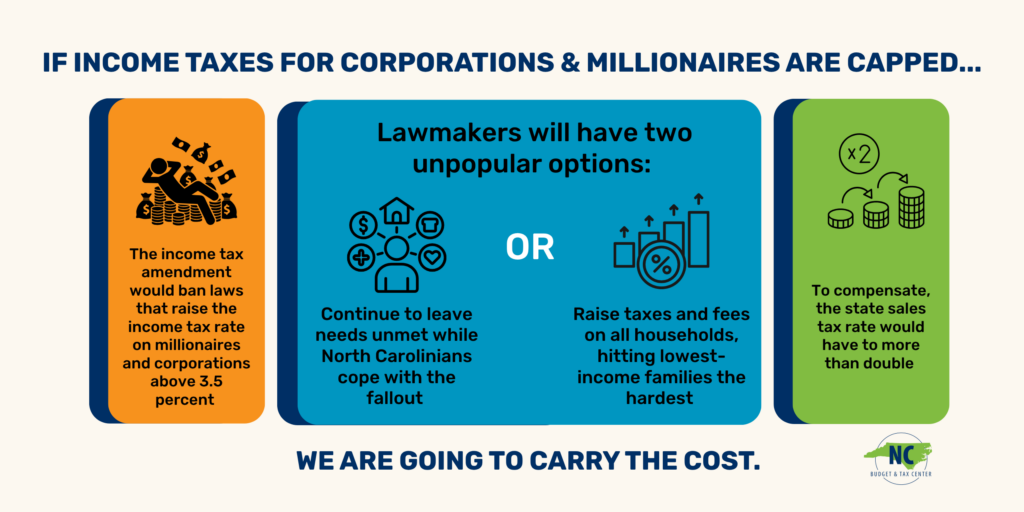
Through the public money our state collects and taxes, we make a collective commitment to our communities, and that includes the rebuilding effort. But right now, there are a series of income tax rate cuts scheduled through 2030 that will primarily benefit large, profitable corporations and the richest 20% of North Carolinians. These scheduled income tax cuts, when fully in effect, will take nearly $14 billion in public money and send it out of state to shareholders and executives, or intended to build the wealth of already wealthy North Carolinians by choosing now to pass those scheduled income tax cuts and focus on western North Carolina, what western North Carolina needs.
00;44;34;12 - 00;45;04;03
The very issues that were raised tonight on this call, we can rebuild a stronger and more equitable region. And that, in turn, will make sure that all of us, our entire state, has the brighter future we all deserve. I am looking forward to working with you all of you, to come together, to show that we're willing to make a collective commitment to the recovery of communities hit hard by climate disasters and Western NC and eastern NC, and every community in between.
00;45;04;06 - 00;45;15;27
That will start by making sure our tax code, as the wealthy and profitable corporations to contribute what they owe. Thank you so much for having me tonight, and I look forward to working together.
00;45;15;27 - 00;45;31;28
Thank you so much, Alexandra. With those remarks, I, I want to thank everyone on the call for being here. Thanks to all the legislators who took the time to be here and listened, really listened to all these Western North Carolinian voices.
00;45;32;01 - 00;45;41;14
And thank you, thank you, thank you to all those in western North Carolina who took the time to be here and share your story.