
Fact Sheet: Unmet Housing Needs in Western NC
Hurricane Helene was the most devastating hurricane to ever hit North Carolina. The storm caused an estimated $12.7 billion in residential damage to about 75,000 homes, including both single- and multi-family units. With homeowners displaced and in need of a place to rent – and while the supply of available rentals was reduced – conditions were ripe for landlords and property management companies to take advantage of the situation by raising rent prices, as often happens following disasters.
Even before the storm, more than 450,000 households in disaster-affected counties were already housing cost-burdened, meaning that they were paying over 30 percent of their income on housing. The hurricane deepened the crisis, as many workers lost their jobs or had their hours reduced, and the tight economy has made it difficult to find another.
Understandably, many disaster survivors in Western NC have struggled to keep up with rent and/or mortgage payments. Property-owners and the courts have responded by carrying out thousands of evictions, which have continued steadily since the storm first hit North Carolina.
In the early months following the hurricane, disaster survivors and advocates called on Chief Justice Newby and former Governor Cooper to implement an eviction moratorium immediately. But these calls were ignored. Now, over 9 months after Helene devastated North Carolina, the state legislature has provided a mere $1,000,000 for rental assistance — and nothing for mortgage relief.
This fact sheet outlines how grossly inadequate NC’s response has been to the housing crisis in Western NC. It makes the case that evictions remain a serious problem in Western NC, and it calls on the NC General Assembly to provide $5 million in additional funds for rental assistance and $5 million in funds for mortgage assistance.
***
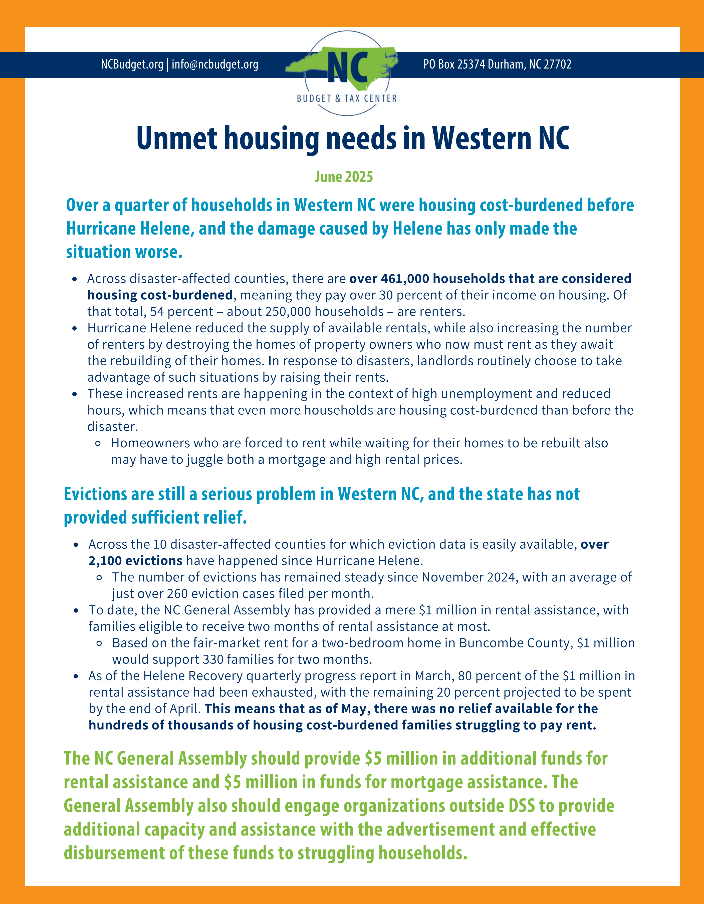
Unmet housing needs in Western NC
Over a quarter of households in Western NC were housing cost-burdened before Hurricane Helene, and the damage caused by Helene has only made the situation worse.
- Across disaster-affected counties, there are over 461,000 households that are considered housing cost-burdened, meaning they pay over 30 percent of their income on housing. Of that total, 54 percent – about 250,000 households – are renters.
- Hurricane Helene reduced the supply of available rentals, while also increasing the number of renters by destroying the homes of property owners who now must rent as they await the rebuilding of their homes. In response to disasters, landlords routinely choose to take advantage of such situations by raising their rents.
- These increased rents are happening in the context of high unemployment and reduced hours, which means that even more households are housing cost-burdened than before the disaster.
- Homeowners who are forced to rent while waiting for their homes to be rebuilt also may have to juggle both a mortgage and high rental prices.
Evictions are still a serious problem in Western NC, and the state has not provided sufficient relief.
- Across the 10 disaster-affected counties for which eviction data is easily available, over 2,100 evictions have happened since Hurricane Helene.
- The number of evictions has remained steady since November 2024, with an average of just over 260 eviction cases filed per month.
- To date, the NC General Assembly has provided a mere $1 million in rental assistance, with families eligible to receive two months of rental assistance at most.
- Based on the fair-market rent for a two-bedroom home in Buncombe County, $1 million would support 330 families for two months.
- As of the Helene Recovery quarterly progress report in March, 80 percent of the $1 million in rental assistance had been exhausted, with the remaining 20 percent projected to be spent by the end of April. This means that as of May, there was no relief available for the hundreds of thousands of housing cost-burdened families struggling to pay rent.
The NC General Assembly should provide $5 million in additional funds for rental assistance and $5 million in funds for mortgage assistance. The General Assembly also should engage organizations outside DSS to provide additional capacity and assistance with the advertisement and effective disbursement of these funds to struggling households.
Table 1: Estimated number of families supported by $1 million in rental assistance by county
| County* | Fair market rent for a 2-bedroom rental | Number of families served for 1 month | Number of families served for 2 months |
| Ashe | $930 | 1075 | 537 |
| Avery | $1054 | 948 | 474 |
| Buncombe | $1512 | 661 | 330 |
| Burke | $1046 | 956 | 478 |
| Caldwell | $1046 | 956 | 478 |
| Clay | $1020 | 980 | 490 |
| Cleveland | $930 | 1075 | 537 |
| Gaston | $1824 | 548 | 274 |
| Haywood | $1223 | 817 | 408 |
| Henderson | $1512 | 661 | 330 |
| Madison | $1512 | 661 | 330 |
| McDowell | $930 | 1075 | 537 |
| Mitchell | $930 | 1075 | 537 |
| Polk | $1046 | 956 | 478 |
| Rutherford | $930 | 1075 | 537 |
| Transylvania | $1150 | 869 | 434 |
| Yancey | $930 | 1075 | 537 |
* Counties included in this sample are those disaster-affected counties with the highest levels of year-over-year increase in people who are looking for work.