Funding local services in North Carolina
To open the dashboard full-size in another browser window, click here.
If you are having issues downloading a PDF from the dashboard below, try opening this link and downloading the PDF from that page.
Across North Carolina, our communities rely on strong public services to live well and get ahead — from safe public school buildings and good pay for educators to reliable emergency services, libraries, and water and sewer systems. Paying for these services requires reliable public funding that is made possible through good tax policy.
This November, North Carolinians will vote on two constitutional amendments related to taxes. One caps income tax rates for individuals and corporations at 3.5 percent, and one requires the state legislature to put limits on local revenue from property taxes. This resource is designed to show how local services are funded, and costs that counties currently have, and how new limits on local funding could affect communities in our state.
Because counties and towns can’t collect income taxes in North Carolina, they rely largely on property tax and sales tax for local funding of core services, along with state and federal funding. Putting limits on property taxes — the biggest source of funding for local governments — and income taxes — the biggest source of funding for state government — would make it harder for our counties and towns to provide the services we need. These limits would also disproportionately benefit wealthy people and profitable corporations.
Property tax limits would constrain the most important source of funding for local services
Property taxes are the main source of revenue for local services. In most counties for Fiscal Year 2026, they accounted for over half of county General Fund budgets.
The NC General Assembly has placed a constitutional amendment on the November ballot that, if approved by voters, would require lawmakers to limit annual growth in local property tax revenue. This is not a direct limit on property tax rates but a “levy limit” on the total property tax revenue local governments can collect. Analysis of the potential impacts of a levy limit from the NC Housing Coalition shows that, if a limit had been in place during their last revaluation year, most counties would have lost revenue they use to deliver the services that make our lives better. Meanwhile, according to the analysis, the average homeowner would save just $84 a year — or $7 a month. But corporate property owners could see big benefits. For example, in Rutherford County the average homeowner would save $54 in property tax payments, while a Meta data center would see their bill cut by $1.2 million.
Local funds are an important contributor to public education
In North Carolina, the state is supposed to be responsible for funding instructional and operational expenses for K-12 public education — things like teacher salaries, materials, and transportation. Counties are expected to pay for capital costs, meaning building construction and maintenance. However, in recent years counties have had to step in and fund a larger share of school instructional costs. Statewide, counties covered over a quarter of costs for public education in the 2024-2025 school year.
More limits on state revenue could mean even more gaps in education funding for counties to fill, while limits on property taxes would make it harder for counties to raise enough revenue to step in.
State funds are a significant source of revenue in many counties, and income tax cuts put those funds at risk
State funding (also called state intergovernmental transfers) plays a key role in funding a variety of services for many counties — especially rural counties. At the state level, income taxes are by far the most important source of revenue — and state revenue has a big effect on local services, both because it affects whether they can directly support local governments, and because when state services are cut, local governments are pressured to step in to fill the gaps.
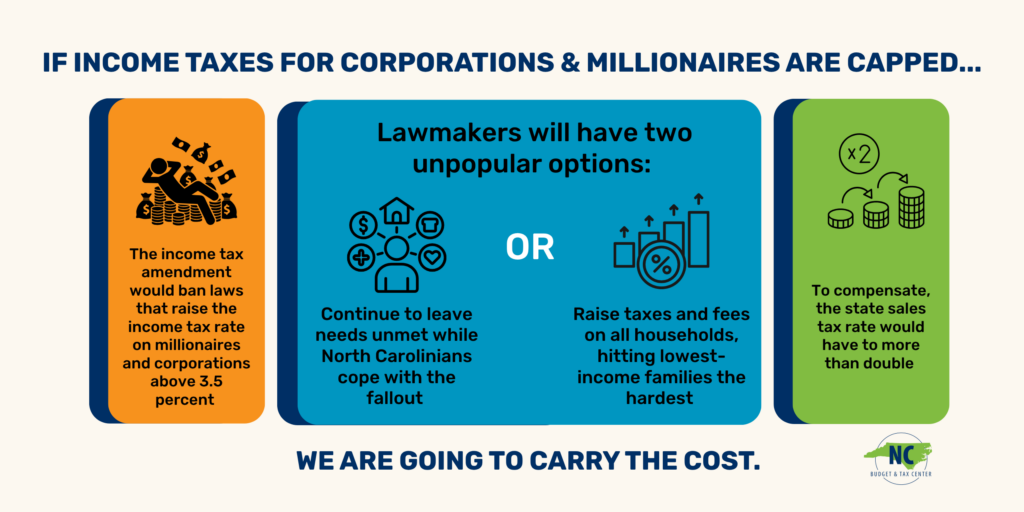
The corporate income tax is already scheduled to be eliminated statewide starting in 2030, and personal income tax cuts are scheduled through at least 2034. Locking low income tax rates into the state constitution would make it harder for North Carolina to make sure millionaires and profitable corporations pay what they owe. It won’t benefit the vast majority of North Carolinians, because it reduces the funding needed to expand opportunity through high-quality public schools, health care, child care, housing, and more.
- 2 out of 3 dollars from personal income tax cuts go to the richest 20% of North Carolina households, who have an average income of about $340,000 a year.
- 9 out of 10 dollars from corporate income tax cuts go to people living outside the state.
Federal SNAP cuts add to county budget pressures
While counties are trying to fund and improve existing services, they also face new costs from federal cuts that the state is shifting onto local governments. H.R.1 made big cuts to federal funding for SNAP food assistance, which 1.2 million North Carolinians rely on to put healthy food on the table. The state is passing these cuts onto counties, including through a plan to withhold a portion of counties’ share of sales tax revenue that was passed in the 2025-2026 state budget.
Statewide, this means almost $220 million in estimated new annual costs for counties for SNAP administration and benefit costs that were previously covered at the federal level.
North Carolina communities are already being asked to do more with less. These proposed tax amendments would make that harder by restricting the two most important sources of state and local revenue, even as counties face growing costs and greater responsibility for funding schools, food assistance, and other essential services.
Sources and Methods
Property tax as a share of General Fund revenue
- Source: NC Association of County Commissioners annual Budget and Tax Survey for FY 2025-2026. Available at https://www.ncacc.org/research-and-publications/research/county-budget-and-tax/. Data are self-reported by counties and do not reflect audited expenditures or revenues.
- Mecklenburg County reported property tax revenues for their General Fund and Debt Service Fund, but total revenues for their General Fund only. This analysis used the property tax revenues reported just for the General Fund available in the county’s Adopted Budget Archives.
- Property tax revenue by county only includes General Fund revenue, and the share is shown as a portion of the General Fund. The General Fund is the main operating account for a local government, appropriates all or most property taxes, and funds the operation of most local services. This data should not be combined with the data on state funds revenue by county, which includes all county revenue and reflects a different fiscal year.
State funds as a share of total county revenue
- Source: Annual Financial Information Reports (AFIR) submitted to the NC Department of State Treasurer for FY 2024-2025. Available at https://logos.nctreasurer.gov/Reporting/Report/External?applicationCode=AFIR.
- This analysis sums all state intergovernmental revenues reported in the AFIR as a share of total county revenue.
- Data are self-reported and may not reflect audited expenditures. Counties with no data shown did not report on their expenditures.
- State fund revenue by county includes all revenue, not just the General Fund. This data should not be combined with the data on property tax revenue by county, which is only for the General Fund and reflects a different fiscal year.
SNAP costs and recipients
- Source for SNAP costs: NC Association of County Commissioners August 2026 Monthly Data Sheet. Available at https://www.ncacc.org/wp-content/uploads/2026/08/2026-NCACC-AP-Data-Fact-Sheet-FINAL.pdf
- Source for SNAP recipients: NC Department of Health and Human Services Food and Nutrition Services Caseload Statistics Reports July 2026. Available at https://www.ncdhhs.gov/divisions/social-services/reports-and-statistics/fns-caseload-statistics-reports.
- To calculate the share of the population receiving SNAP benefits we used county population projections for 2026 from the NC State Demographer. Available at https://www.osbm.nc.gov/facts-figures/population-demographics/state-demographer-data.
- To learn more about how the state is shifting federal SNAP costs onto counties see https://ncbudget.org/state-tax-cuts-are-leaving-counties-to-cover-new-snap-costs/.
Local funding for public schools
- Source: NC State Board of Education and Department of Public Instruction Statistical Profile, Local Education Agencies, Table A7 — Current Expenditures by Source of Funds, School Year 2024-2025. Available at https://apps.schools.nc.gov/public/f?p=145:113. This data includes only operational expenses and excludes capital expenses.
- For counties with multiple Local Education Agencies (LEAs, a.k.a. school districts), we combined data to calculate the total for that county. Per pupil spending was adjusted based on average daily membership by LEA. One district, Kannapolis City Schools, has schools in both Cabarrus and Rowan counties. This data was assigned to Cabarrus County because a significant majority of Kannapolis schools and pupils are located in Cabarrus.
- Locally funded teaching positions provided by special data request from the NC Public School Forum.
Property tax levy limit
- Source: NC Housing Coalition, Analysis of North Carolina’s Proposed “Property Tax Cap,” August 2026. Available at https://nchousing.org/wp-content/uploads/2026/08/Levy-Limit-Analysis.pdf.
- The NC Housing Coalition’s analysis is based on a 2% property tax levy limit, which is the policy proposal presented by the Tax Foundation to NC House Select Committee on Property Tax Relief and Reform during the 2026 legislative session.
- The analysis is retroactive and based on property tax revenue in revaluation years, which are the years that often show the most significant changes in property tax payments. It should not be interpreted as a prediction of the exact impact of a property tax levy on individual counties, but instead as an illustration of how levy limits of the type discussed in the legislature could affect county revenue.
- For further details on this analysis and data sources see the methodology section of the NC Housing Coalition’s report.
Income tax cuts
- Data on the distribution of tax cuts by income and state residence from special data request to the Institute on Taxation and Economic Policy.