Fact Sheet: Tax ballot measures are bad for local business
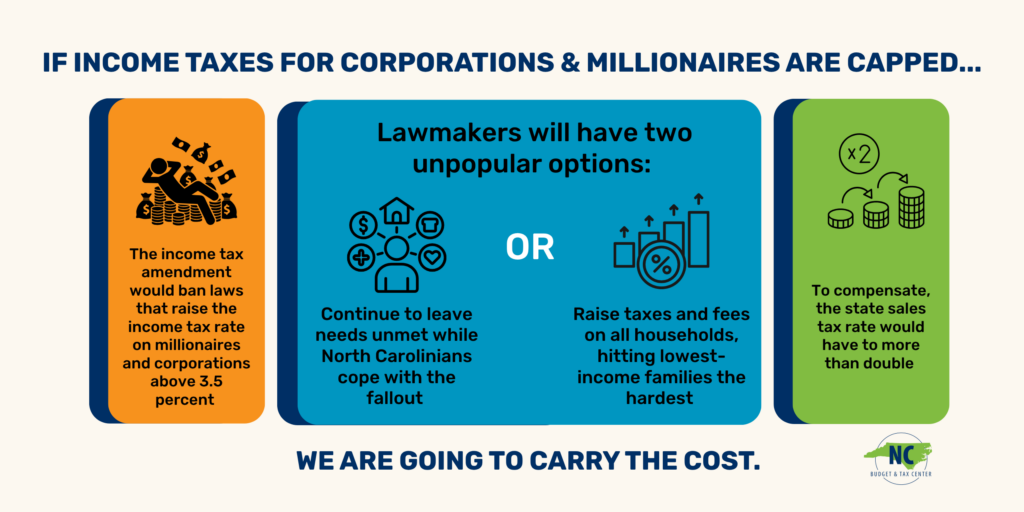
North Carolina voters will see two tax measures on their ballots in November that will limit state and local government revenue options and lock in outsized tax breaks for big business. These measures would lower the maximum allowable personal and corporate income tax rates to 3.5 percent and impose a limit on property tax revenue growth year-over-year. The result: putting infrastructure, services, and quality of life at risk in our communities, while primarily benefiting large multi-state and profitable corporations and the richest 1 percent.
These tax ballot measures are especially bad for local and smaller businesses. Here’s why.
Small businesses will see little direct benefit to their bottom-line from low income tax rates, and they will feel the impact through cuts to services and higher fees
Most small businesses are not subject to the corporate income tax at all, and 80 percent of small businesses make less than $50,000 in annual taxable income, so even eliminating the personal income tax wouldn’t make any significant difference. Even for businesses that do pay the corporate income tax, it represents less than one-quarter of 1 percent of total business costs and is only paid on the portion of sales the company generates in the state. In short, low income tax rates have a very limited direct effect on the bottom-line of businesses.
But small businesses will feel the impact through cuts to services, higher fees, and reduced consumer demand.
- Small businesses benefit when public investments — like affordable child care, transportation, and workforce supports — are fully funded and help connect workers to jobs and markets. By restricting revenue through limits on income tax rates, these public investments are constrained, and governments are less able to respond in times of crisis such as pandemics, climate disasters, and economic downturns. In turn, businesses that rely on these services or need support suffer through losses in productivity; increased costs of hiring, training, and retention of workers; and lack of support.
- With rising costs and decades of income tax cuts for profitable corporations and the wealthy few, NC will be unable to maintain current service levels in the coming years. By locking in low income tax rates, lawmakers will have to look elsewhere to raise revenue, including fees that fall on small businesses such as building permitting and business registration fees.
- Small businesses thrive when consumers have income to spend. But cutting services to restrict income tax rates for the benefit of the ultra-wealthy and out-of-state shareholders reduces consumer demand and harms local economies.
Decades of income tax cuts haven’t contributed to economic growth, but they have fueled record profits and increased market share for big business
There is no evidence that low income tax rates support job or economic growth. In fact, annual GDP growth in NC lags regional neighbors like Georgia and South Carolina, which have higher personal and corporate income tax rates. It’s small businesses that generate the lion’s share of annual job growth in NC, and low income tax rates hurt rather than help small businesses.
However, when corporations receive unearned income tax cuts, they are able to use this excess cash to outbid small businesses for skilled talent, run ads, absorb temporary losses by reducing prices below small business competitors, and even outright acquire smaller rivals. In this way, limiting the corporate tax rate increases the ability of large, multi-national corporations to steal market share at the expense of small businesses. These sort of tactics that increase the market power of corporations are estimated to cost the typical US household $5,000 per year in higher prices, lower wages, and lost growth.
While the income tax cap provides the greatest benefit to big business, the property levy limit would give little relief to small businesses and add to the windfall
Property levy limits restrict the rate at which local property tax revenue can grow year-over-year. This limits the total property tax revenue local governments can collect, NOT property tax bills of individual property owners. This means individual property owners can still see their bills increase even if revenue exceeds the limit.
While levy limits can provide substantial benefits for large developers, property taxes are a small part of total costs for most businesses, so levy limits will have little effect on their bottom-line. But as with income tax caps, they will impact small businesses through cuts to services and higher fees.
Since property taxes make up the largest share of revenue for local governments in NC, imposing levy limits would mean needing to find alternative sources of revenue like higher permitting fees or cutting or forgoing services, especially as federal costs that are being shifted onto states are in turn being shifted onto local governments. These cuts to services may include programs that train and upskill workers, that screen and match unemployed workers with employment opportunities, and others that benefit small businesses through providing regulatory assistance, site selection and procurement support, and incubator subsidies.
North Carolina’s business climate depends on public investment
Research has shown time and again that access to good local public schools is a consistent top reason people choose where they want to live. Businesses consistently prioritize educational attainment of the workforce, infrastructure to get goods to markets and people to work, and supported supply chains as critical to their location decisions. North Carolina’s business climate depends on the capacity to invest in transportation, public education, and quality of life in communities. Both ballot measures impede this capacity and will have harmful effects on small business if passed.