
Tax amendments put North Carolina’s infrastructure for business success at risk
North Carolinians’ skills, innovation, and labor are fueling our state’s economy. Investment in people’s well-being and community infrastructure sets the foundation for business success and continues to make North Carolina a place where businesses are relocating, starting up, or expanding their operations.
But limits on how we fund key infrastructure for business success — public schools and universities, transportation, and broadband — could not only downgrade our quality of life but put at risk the very things that businesses look to when making decisions about expansion or location.
Infrastructure investment requires both reliable and flexible revenue options and the ability to borrow at low costs by maintaining a strong bond rating. North Carolina’s AAA bond rating from the three major credit rating agencies (Moody’s, S&P, and Fitch) has long been a point of pride for state leaders — and an important financial asset for businesses, state and local government, and North Carolinians. While credit ratings for local governments in North Carolina vary, they have a big influence on whether counties and cities can borrow funds to make important capital improvements.
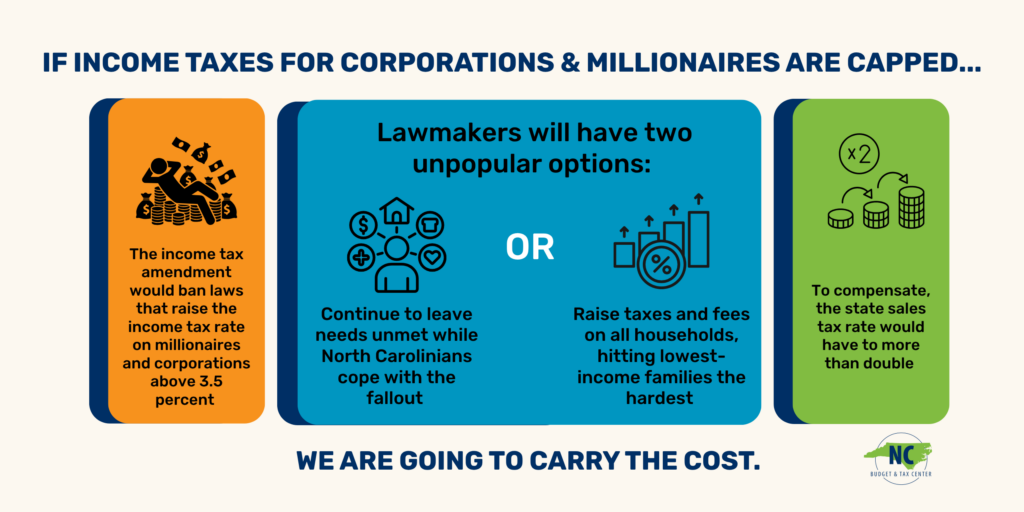
Constitutional amendments that limit tax revenue not only put the ability to directly fund infrastructure needs and the necessary factors for business success like post-secondary attainment, quality public schools, efficient and fair courts and quality of life but also could put state and, or local bond ratings at risk.
NC communities have big capital costs, catching up on them to stay competitive requires greater flexibility in financing not revenue limits.
- North Carolina’s public school facility needs alone have been estimated at more than $16 billion when adjusted for inflation since the last survey of needed upgrades.[1]
- North Carolina’s local leaders have identified $144 billion in transportation projects for just $5 billion in available state funding, which has prompted discussion of toll roads and the need for alternatives to the gas tax. [2]
Constitutional amendments that limit state and local governments’ capacity to raise revenue could raise costs, delay maintenance, and undercut critical infrastructure
- Limits on revenue options available to future legislators amidst rapid population growth and industry expansion across North Carolina risk putting critical projects on hold, delaying maintenance and modernization of infrastructure, and blocking expansion of new infrastructure, like broadband, to rural communities.[3]
- Both constitutional tax amendments on the ballot restrict policymakers’ ability to raise public revenue — which ratings agencies consider a negative factor when determining creditworthiness.[4]
- Limits on income and property tax will create further pressure on other sources of revenue. To fund the growing cost of transportation projects, North Carolina state legislators have already tapped into sales tax revenue, increased fees for DMV services, and added tolls for previously free ferries.[5]
Low cost of borrowing has made important projects possible.
- Statewide bonds in North Carolina have recently been used to upgrade facilities at public universities and community colleges, improve water and sewer infrastructure in local communities, and support public safety initiatives.[6]
- Local governments in North Carolina have sought voter approval for and issued bonds to resurface roads and improve pedestrian safety, build and renovate school buildings, and construct and preserve affordable housing.[7]
Ratings agencies that assess governments’ ability to pay back borrowed funds care about revenue limits
- Credit rating agencies take into consideration whether governments have flexibility to raise the revenue needed to pay back their loans. They name constitutional limits on taxes as a negative factor for states’ ratings because they severely constrain governments’ options.
- Externally imposed property tax caps, and the requirement of voter approval to raise local revenue, are considered negative factors for local governments.[8] Rating agencies also take state context into consideration, including whether the state is shifting costs onto local governments, an increasing pattern in North Carolina.
- Tax cuts in other states have harmed their credit ratings. Following deep income tax cuts, S&P and Moody’s both downgraded Kansas in 2014.[9] Two years later, Moody’s changed Kansas’ credit outlook from “stable” to “negative”, due to the state’s ongoing failures to balance its budget.[10]
- When Georgia lawmakers considered a ballot initiative to cap income taxes in the state Constitution, Moody’s issued a warning that the limit could affect their credit rating.[11]
[1] Public Schools First NC. “NC Public School Facility Needs.” October 7, 2026. https://publicschoolsfirstnc.org/issues/education-budget/nc-public-school-facility-needs/.
[2] Campbell, Colin. “Q&A: NC’s Transportation Funding Shortage Could Lead to More Tolls.” WUNC News, June 8, 2026. https://www.wunc.org/politics/2026-06-08/nc-transportation-funding-shortage-tolls-ncdot-daniel-johnson; Jurkowitz, Mark. “NCDOT Will Make Ferry Toll Recommendations at Oct. 8 Meeting, Livestream Available.” The Outer Banks Voice, October 6, 2026. https://www.outerbanksvoice.com/2026/10/06/ncdot-to-make-ferry-toll-recommendations-at-oct-8-meeting-livestream-available/.
[3] Kille, Leighton Walter. “Do Tax and Expenditure Limits Hinder the Condition of Public Infrastructure? The Case of the Nation’s System of Bridges.” The Journalist’s Resource, August 6, 2013. https://journalistsresource.org/economics/tax-expenditure-limits-infrastructure-bridges/.
[4] Rating Methodology: US States and Territories. Moody’s, 2025. https://www.moodys.com/research/Rating-Methodology-US-States-and-Territories-Rating-Methodology–PBM_1440164; Methodology For Rating U.S. Governments. Ratings. S&P Global, 2024. https://www.spglobal.com/ratings/en/regulatory/article/-/view/type/PDF/id/3448944; Rating Methodology: US Cities and Counties. Moody’s, 2026. https://www.moodys.com/research/Rating-Methodology-US-Cities-and-Counties-Rating-Methodology–PBM_1482995; U.S. Public Finance Local Government Rating Criteria. Fitch Ratings, 2026. https://www.fitchratings.com/research/us-public-finance/us-public-finance-local-government-rating-criteria-01-05-2026.
[5] North Carolina Department of Transportation. “Finance & Budget.” September 11, 2025. https://www.ncdot.gov/about-us/how-we-operate/finance-budget/Pages/NCDOT; Jurkowitz, Mark. “NCDOT Will Make Ferry Toll Recommendations at Oct. 8 Meeting, Livestream Available.” The Outer Banks Voice, October 6, 2026. https://www.outerbanksvoice.com/2026/10/06/ncdot-to-make-ferry-toll-recommendations-at-oct-8-meeting-livestream-available/.
[6] NC Chamber. “Strong Senate Vote Puts $2-Billion Infrastructure & Education Investments on 2016 Ballot.” September 24, 2015. https://ncchamber.com/2015/09/24/strong-senate-vote-puts-2-billion-infrastructure-education-investments-on-2016-ballot/; NC Community Colleges. “NC Voters Approve $350 Million for NC Community Colleges.” March 17, 2016. https://www.nccommunitycolleges.edu/news/nc-voters-approve-350-million-for-nc-community-colleges/.
[7] City of Gastonia. “Transportation Bond Referendum Projects.” February 6, 2025. https://www.gastonianc.gov/transportation-bond; Person County Schools. “School Bond Referendum.” 2026. https://www.pcsnc.org/page/bond-faq/; Laidlaw, Justin. “Durham Has Spent Nearly All of the $95 Million Affordable Housing Bond Funds.” INDY Week, January 14, 2026. https://indyweek.com/news/durham-has-spent-nearly-all-of-the-95-million-affordable-housing-bond-funds/.
[8] Methodology For Rating U.S. Governments. Ratings. S&P Global, 2024. https://www.spglobal.com/ratings/en/regulatory/article/-/view/type/PDF/id/3448944; Rating Methodology: US Cities and Counties. Moody’s, 2026. https://www.moodys.com/research/Rating-Methodology-US-Cities-and-Counties-Rating-Methodology–PBM_1482995; U.S. Public Finance Local Government Rating Criteria. Rating Critera. Fitch Ratings, 2026. https://www.fitchratings.com/research/us-public-finance/us-public-finance-local-government-rating-criteria-01-05-2026.
[9] Leachman, Michael. “A Deserved Downgrade of Kansas’ Bonds.” Off the Charts: Policy Insight Beyond the Numbers, August 11, 2014. https://www.cbpp.org/blog/a-deserved-downgrade-of-kansas-bonds.
[10] MSC Radio Group. “Moody’s Downgrades Credit Outlook for KS.” May 4, 2016. https://mscnews.net/local-news/834342.
[11] Bluestein, Greg. “Georgia’s New State Income Tax Cap Raises a Wall Street Eyebrow.” The Atlanta Journal-Constitution, November 17, 2014. https://www.ajc.com/blog/politics/georgia-new-state-income-tax-cap-raises-wall-street-eyebrow/eVDuAqOCNt25A146yhvFvK/.